INDIGENOUS APPROACHES AND METHODS FOR ALL LEARNERS
ND Indigenous Learning Principles
Begin with a classroom you remember. Consider the classroom you create.
Explore four principles developed through North Dakota Indigenous leadership and educational collaboration. Read each principle, try an activity, and learn from your own experiences as a teacher and as a learner.
THE PROJECT AND ITS ROOTS
A shared framework grounded in Indigenous knowledge
The North Dakota Learning Principles project brings Indigenous approaches and methods into conversation with educators’ work with all learners. The Teachings of Our Elders project page, published in June 2021 and updated in July 2021, records four principles, their implications for educators, guiding themes identified by Indigenous leaders, and the development team.
Those guiding themes connect new learning with lived experience; insist on Indigenous knowledge that is specific to local communities, places and learners; make room for different ways to demonstrate growth; and value time, revisiting and intrinsic motivation. They also call educators to examine bias and inequity. Strong, trusting relationships hold this work together.
The source presents these principles alongside North Dakota’s Native American Essential Understandings. Here, the principles invite reflection on how learning happens; the lesson workspace provides ways to explore NDNAEUs, Elder interviews and curriculum connections.
History and guiding themes summarized from Teachings of Our Elders: North Dakota Learning Principles. The source does not provide a complete development timeline; publication dates describe the webpage, not the beginning of the project.
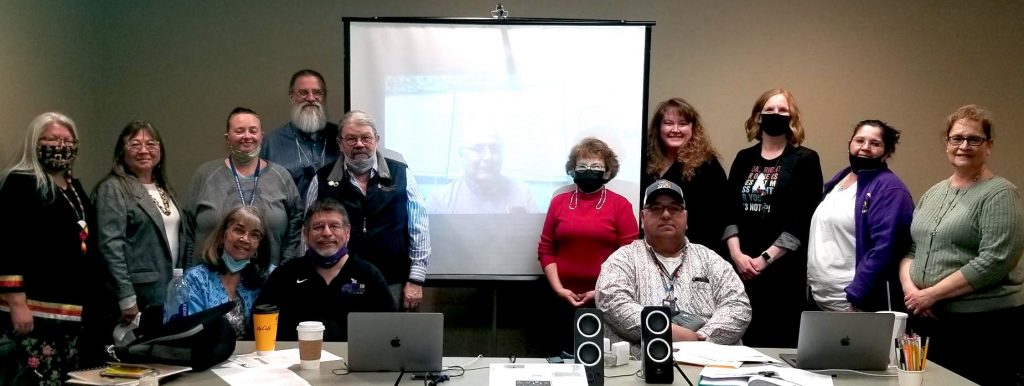
The North Dakota Learning Principles Development Team
Names and affiliations as credited on the original project page:
- Carol Davis (Turtle Mountain Band of Chippewa)
- Marc Blue Stone (Mandan, Hidatsa & Arikara)
- Charles Moran (Mandan, Hidatsa & Arikara)
- Pat Walking Eagle (Spirit Lake Dakota)
- Baron Blanchard (Bismarck Educator)
- Erik Holland (Curator of Education, State Historical Society of North Dakota)
- Kathy Froelich (Mandan, Hidatsa & Arikara)
- Melissa Cournia (Bismarck Educator)
- Flo Laducer-Garrett (Mandan, Hidatsa & Arikara)
- Oliver Gourd (Spirit Lake Dakota)
- Joyce Shining Oneside (Turtle Mountain Band of Chippewa)
- Danielle Stuckle (Education Outreach Coordinator, State Historical Society of ND)
- Amy Mossett (Mandan, Hidatsa & Arikara)
- Lucy Fredericks (Standing Rock Lakota)
- Scott Simpson (Learning Specialist)
- Sharla Steever (Learning Specialist)
PRINCIPLE 1 OF 4
Learning is purposeful
Original principle
1. Learning is purposeful as reflected in standards, culture, the individual, group identities, relevance to the learner, the teacher and the community. Learners are sacred, interconnected with their ancestors, Mother Earth and need acknowledgment of this connection in their learning environments.
Therefore…
1a. Educators must commit to understand, appreciate, celebrate and connect with learners’ individual identities, cultural heritage, first languages, valued sites and practices, family backgrounds and community events.
1b. Educators must holistically integrate cultural content and value culturally responsive practices into all aspects of curriculum and learning rather than merely providing “cultural add-ons,” in order to effectively build trust with learners.
Source: North Dakota Learning Principles development team · Teachings of Our Elders, Principle 1 and educator commitments.
TRY AN ACTIVITY
Trace a lesson back to its purpose
Choose one lesson you have taught recently. Make three columns: the required learning, what connects it to learners’ lives, and what connects it to their community or place. Mark whose knowledge is present and whose is missing. Revise one central task so that a locally grounded perspective helps shape the learning from the beginning. Use community-approved sources and relationships; invite contributions without expecting any student to represent a whole culture.
REFLECTIVE LEARN FROM
Learn from your classroom experiences
- As a learner: When did a teacher connect learning with something that mattered to you, your family or your community? What changed in your attention or sense of belonging?
- As a teacher: Where do students’ languages, identities and relationships shape the substance of your lessons? Where do they appear only as an occasional addition?
- Learn from the experience: What could you ask learners or families, with an option to decline, that would help you discover a meaningful purpose you have overlooked?
PRINCIPLE 2 OF 4
Learning is personal
Original principle
2. Learning is personal and impacted by families, our past and our future, our imaginations and values, and historic and current traumas. Learners are unique, and thrive in a safe and supportive learning environment.
Therefore…
2a. Educators must learn from their learners while recognizing learners’ experiences and knowledge as important curricular resources.
2b. Educators must have an awareness of and take into account learners’ historical/generational privileges, traumas, economic situations, abilities, broad or limited experiences as they design and facilitate learning opportunities.
2c. Educators must recognize educational and societal inequities and consider themselves active change agents working toward equity.
Source: North Dakota Learning Principles development team · Teachings of Our Elders, Principle 2 and educator commitments.
TRY AN ACTIVITY
Notice the learner, then examine the environment
Recall a classroom moment when someone withdrew, resisted or struggled. Describe only what you observed, then list several possible explanations without diagnosing the learner. Review access to materials, time, accommodations, relationships and ways to demonstrate understanding. Select one barrier you can change. Ask privately what support would help; do not request disclosure of trauma or confidential family experiences.
REFLECTIVE LEARN FROM
Learn from your classroom experiences
- As a learner: When did a teacher notice knowledge or strengths that others had overlooked? When were assumptions made about you, and how did those assumptions affect your learning?
- As a teacher: Whose experiences count as knowledge in your classroom? Which routines may privilege some learners while making participation harder for others?
- Learn from the experience: What would you change in the environment before asking the learner to change? How could learners help you judge whether that change improves access and safety?
PRINCIPLE 3 OF 4
Learning is invitational
Original principle
3. Learning is invitational and it can’t be forced. It needs to be intrinsically motivated with learning opportunities presented in multiple modes (oral, written, song, story, experiential). Learners are curious, naturally motivated to learn in the context of strong, trusting relationships between educators and learners.
Therefore…
3a. Educators must enable learners to learn intrinsically–using their own curiosities and interests– making connections that are relevant in their lives.
3b. Educators must be trustworthy and work to build positive relationships with all students, families, and communities who historically have been and continue to be mistreated.
Source: North Dakota Learning Principles development team · Teachings of Our Elders, Principle 3 and educator commitments.
TRY AN ACTIVITY
Turn an assignment into an invitation
Take an assignment that depends heavily on compliance or rewards. Keep its learning purpose, but offer a meaningful question and a choice of approaches: oral explanation, writing, story, visual work or an appropriate hands-on experience. Identify how each approach can show the same understanding. Invite learners to suggest another route. Plan a small, consistent action that strengthens trust before introducing the task.
REFLECTIVE LEARN FROM
Learn from your classroom experiences
- As a learner: Recall something you pursued because you were curious. What did the teacher do—or leave room for—that helped you keep learning?
- As a teacher: What do your tasks invite learners to wonder about? When might a reward, deadline or single required format be taking the place of a meaningful invitation?
- Learn from the experience: How will you listen when a learner does not accept the invitation? What might their response teach you about relevance, trust, readiness or access?
PRINCIPLE 4 OF 4
Learning is a journey
Original principle
4. Learning is a journey allowing whole learners to progress in non-linear ways in the company of other learners through a growing understanding of North Dakota tribes. Learners are intuitive and are empowered when their needs are met in a holistic way.
Therefore…
4a. Educators must construct learning opportunities from North Dakota tribal sources– research that is current; local perspectives and knowledge that are authentic, specific and not genericized.
4b. Educators must foster the growth and well-being of learners in all ways– cognitively, emotionally, physically, socially and spiritually.
Source: North Dakota Learning Principles development team · Teachings of Our Elders, Principle 4 and educator commitments.
TRY AN ACTIVITY
Revisit learning and widen the evidence
Choose an important concept and plan three encounters with it over time, each in a different context or with deeper complexity. Offer more than one way to show growth. Review a source you use about North Dakota Indigenous peoples: identify its Nation or community, author or knowledge holder, date and context. Replace generic claims with specific, current, locally grounded sources. Plan room for movement, relationships, reflection and rest alongside academic work.
REFLECTIVE LEARN FROM
Learn from your classroom experiences
- As a learner: When did you understand something only after returning to it? What would a single test or first attempt have missed about your growth?
- As a teacher: Where can learners revisit and revise? How do you attend to intellectual, emotional, physical, social and spiritual well-being while respecting each learner’s beliefs and boundaries?
- Learn from the experience: Which local tribal sources or community relationships could deepen this learning? What permissions or guidance do you need, and how will you recognize growth that follows a different path?
CARRY THE LEARNING FORWARD
Your reflections and next steps
Your entries stay in this open page and are not sent to a server or saved by this reflection tool. Copy or download them before leaving or refreshing. Please leave out names and confidential information about students or families.
Reference: North Dakota Learning Principles development team. North Dakota Learning Principles: Indigenous Approaches and Methods for All Learners. Teachings of Our Elders. Original project page (accessed October 19, 2026). New activities and reflection questions: ND Indigenous Lesson Workspace companion materials.